Posts

Showing posts with the label Big Data

Book Review: Weapons of Math Destruction (Cathy O'Neil)

Image
This post marks my first attempt in trying to force myself to gain a better understanding of the books that I've read. Previously, I find myself reading books after books without being able to recall the important things that I've learned earlier. It's rather frustrating to be honest. So I'm trying this out as a way for me to push myself to understand the book and synthesize the various concept and ideas that are conveyed from the book. A disclaimer: My reviews will not attempt to be neutral or unbiased - as I feel that any attempt for me to try and write such kind of a blog post would result in a dry and boring outcome. Guess you could say that it'd probably be much more of a rant rather than review. Moving on. I bought the book from Amazon quite awhile back in April and it has been on the shelf for quite sometime as I was another book at that time. The outline is rather interesting, as it highlights the pitfalls of big data implementation from a f...
Modelling the Ebola Outbreak using Wolfram

The recent outbreak of the Ebola virus disease (EVD) has shown how quickly diseases can spread in human populations. This threat is, of course, not limited to EVD; there are many pathogens, such as various types of influenza (H5N1, H7N9, etc.) with the potential to cause a pandemic. Therefore, mathematical modeling of the transmission pathways becomes ever more important. Health officials need to make decisions as to how to counter the threat. There are a large number of scientific publications on the subject, such as the recent Science publication by Dirk Brockmann, which is available here. Professor Brockmann also produced videos to illustrate the research, which can be found on YouTube (video1, video2, video3). It would be interesting to reproduce some of the results from that paper and generally explore the subject with Mathematica. Full article here:  Modeling a Pandemic like Ebola with the Wolfram Language

Journey in Data Science

Image
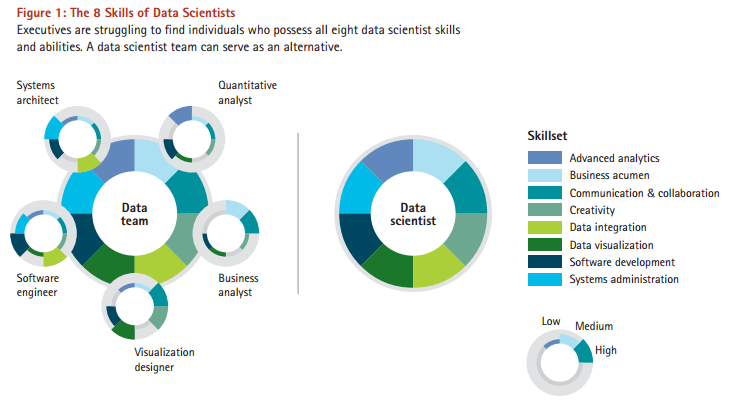
Working in a team of data science enthusiast can have it's benefits. In our team of a few, none of us can claim we're good in data science and/or big data analytics as we're pretty much new in this field. Data scientists are hard to come by, and most articles out there can attest to that. Accenture in this suggested a nice idea in their article " The Team Solution to the Data Scientist Shortage ", if a data scientist person is hard to find - why not have/build a team that has the necessary skills of a "data scientist"? Inspired by this, I've set myself a goal to at least master some of the necessary skills that make up a data science guy. 8 skills of a Data Scientist, from the Accenture article mentioned above. Which makes sense really. To be a master of all the above mentioned area would consume an insane amount of time. Thus to be able to segregate the task around and focus on achieving the end goal - together - as a team; would mean ...

Models

Image
When we talk about big data analytics, the usual topic of discussion would normally revolve around Hadoop, Pig, MapReduce, NoSQL - platforms basically. Granted - those technologies are the enablers of big data, for without which - one can't store big data in their data warehouse. For now though, I'd like to focus on the math. The models to be precise. For without which, one can't derive any usable use cases anyhow with all those data that you have (you might be able to get those low hanging fruits, but over the years - you will have to put on your math hat as well). Below is a link for a course in Coursera which I find to be perfect for beginners like myself who's rather new with statistics and the different models that can be used to solve different questions. The reason I'm mentioning this course in particular is because I like the pace at which it is going and how the presenter is able to articulate complex ideas in simple words. https://class.courser...