Posts

Showing posts with the label Concept

A Basic Recipe for Machine Learning
Image
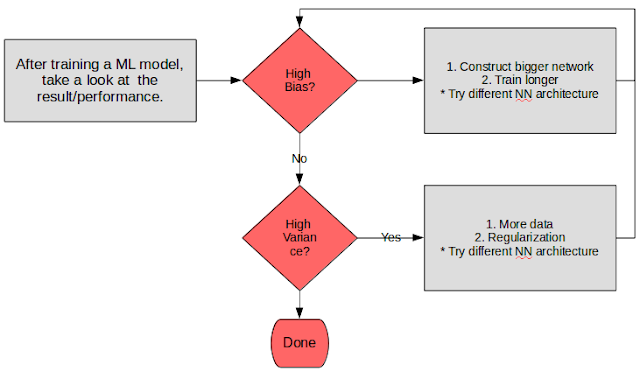
Ever since wrapping up the three Deep Learning courses by Andrew Ng I've been meaning to write down some of the gems that he's highlighted throughout the course. One of the nice ones that I felt needed to be written down is his general recipe to approaching a deep learning algorithm/model. I've basically summarized it in a flowchart below (because everybody loves a flowchart right?) Basic deep learning recipe What is bias and variance? The below diagram is the typical explanation that I'm sure most of us are used to.  Graphical illustration of bias and variance How can we know if we have high bias or high variance?  For high bias, we could take a look at the training set performance. A poor performance is an indicator of a poor model fit, and signals that we could try to apply a bigger network to get a better fit of the model. For high variance, we could take a look at the validation set (or dev set - as Andrew calls it) performance. ...

Person Movement Prediction Using Hidden Markov Models

Humans typically act in a certain habitual pattern, however, they sometimes interrupt their behavior pattern and they sometimes completely change the pattern. Our aim is to relieve people of actions that are done habitually without determining a person’s action. The system should learn habits automatically and reverse assumptions if a habit changes. The predictor information should therefore be based on previous behavior patterns and applied to speculate on the future behavior of a person. You can get the complete article here .

Hotbilling Concept

The below article was taken from Hot Billing Concept by Advanced Multimedia System Design . Prehistory Darwin teaches us that far ancestors of billing systems were simple log files, or record books. All they could do automatically was regular information storage, " The client dialed in at 19:00 and disconnected at 21:00 "; information retrieval was a less trivial procedure. When computers left the developers' pools and migrated to the commercial land, logs had to be taught to detect account overdraft automatically, not at the end of the month. Billing systems of the newer generation were reptile guardians, timing a given delay, " This is the first day of the rest of your life! ", and biting the connection off when the session timed out. But the evolution went on. Cold-blooded billing systems could prevent a single-user debit account with a constant dollars-per-minute rate from overdraft; they failed if faced a herd of users exploiting a single shared...

SS7 Architecture

Image
Below is a picture depicting the SS7 architecture. With SS7, a packet data network overlays and controls the operation of the underlying voice networks, signaling information is carried on an entirely different path than voice and data traffic. Signaling in essence does not take a lot of time, hence it is possible to multiplex many signaling messages over one channel - and that's why the signaling system is a packet network. SS7 entire architecture performs out-of-band signaling (in which conversation and signaling take over different paths). It (the architecture) defines the procedure for the setup, ongoing management, and clearing of a call, and it enables the passing along of customer-related information that helps in routing calls. The key components of SS7 are: 1. SSP:Service-switching points Them switches that originate and terminate calls. It serves as the source and destination point for the SS7 messages 2. STP: Signal transfer point Responsible for translatin...